Total Pageviews

Showing posts with label Kasouf. Show all posts

Monday, June 3, 2013

mountain zebra ~ Asia Devaul~

mountain zebra

   common name:  mountain zebra 
scientific name:  equus zebra
size: 7 feet to 8.5feet and anywhere from 550 lbs to 800lbs
packs or solitary: a pack that usually consists of 1 male and up to 5 female the male controls the group until defeated by another male


predator or prey: the mountain zebra usally falls prey to lions hyenas leopards cheetahs and African wild dogs.

 Mountain zebras are herbivores they eat grass , bark, leave and trees. 
sleeping habits:  they sleep standing up and only when they are in large groups that will warn them of danger. They are mainly active during the day and rarely moving during the night time


 Where do Mountain zebras live: They live in Nambia which is located in south Africa. 
more specifically in mountainous ranges, during colder weather they move to lower elevations to graze and seek shelter from caves and or wooded areas.
population Data:  in the 1950s there were less then 100 Mountain Zebras
current population: as of 2000 there were close to 1,200 zebras all over in Nambia
Reasons for population decline: 
  • Being hunted for their skins
  • competition with farmers for grazing
  • loss of habitat due to agriculture
  • cross breding between 2 sub species 
What is being done to protect Mountain Zebras: They are being kept in protected environments where the group size, individual identies, activity, location, and other changes such as the birth of a foal (Baby mountain zebra) are tracked. They also keep track of their zerbas and their parents that way it is possible to look back at a family tree if needed for medical purposes.

                                                                              
other facts-

  • Mountain Zebras mate all year 

    • round sexually mature at 3-6 years old  

      • pregnant for a year (12 months) The stripes of a 

        • zebra are like human. finger prints no 2 patterns are identical.    

Tuesday, May 28, 2013

The White Tiger


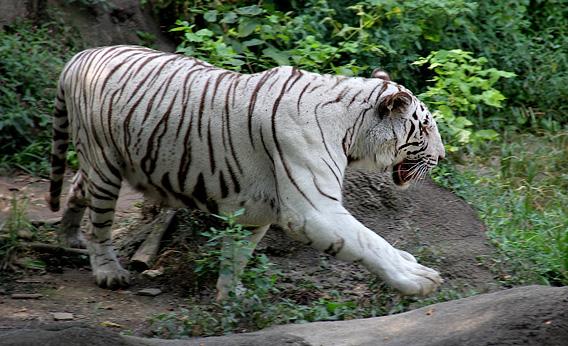
The White Tiger is a subspecies of Tiger, found throughout the Indian subcontinent. Their coloration is dependent on a defective, recessive gene that is passed on from their parents. White Tigers has become even rarer in the wild due to trophy hunting or capture for the exotic pet trade. handful of zoos and animal sanctuaries around the world with these large and beautiful felines often being the star attraction. The Bengal Tiger and The White Tiger is considered to be the second largest species of Tiger in the world after the Siberian Tiger.

The White Tiger is a large and powerful animal that can weigh up to 300kg and reaches more than 3 meters in length. White Tigers aren't albino as they still carry some form of pigment that creates their fur color. Like other Tiger species, the White Tiger has black or dark brown stripes that run vertically along it's body, the pattern of which is unique to both the Tiger species. Along with the change in fur color, the gene carried by the White Tiger's parents also means that they have blue eyes rather than the green or yellow colored eyes of normal Bengal Tigers. Despite the beauty of the White Tiger's fur it give these individuals a disadvantage as they are not so easily camouflaged into the surrounding jungle.

The White Tiger would once have been found throughout much of India and the surrounding countries but their range has decreased dramatically, particularly over the past 100 years or so. Today the Bengal Tiger is found in small pockets of its natural habitat in India, Nepal, Bhutan and Bangladesh, and although populations are severely declining, they remain the most numerous Tiger species in the world. They are found in a variety of habitats including tropical forests, mangrove swamps and moist jungles that generally support dense vegetation and have a good source of fresh water. Although the White Tiger could once be found in the wild, it is very rare for the gene carrying parents to actually mate, and with the rapidly declining numbers of Bengal Tigers throughout their natural range, the chances of White Tigers being produced are becoming less every day.


The White Tiger is a solitary animal. This allows this large predator to sneak up on prey more effectively in the dense jungle. Although the White Tiger is not nocturnal, they do the majority of their hunting at night because its cooler and a lot of animals sleep at night which means if they wake up they may be a little slower then when their fully awake. White Tigers have incredible hearing and sight which, along with their stealth, helps them when hunting in the jungle in the dark. Each Tiger occupies a large territory that is marked by urine and claw marks on trees and can be 75 miles long. They are solitary animals except for during the mating season, male White Tiger territories can overlap with those of a number of females', particularly in areas which are high in prey. Male White Tigers defend their patch fiercely from other males trying to steal their spot.


The White Tiger is a carnivorous animal meaning that it only hunts and eats other animals in order to gain the nutrition that it needs. The White Tiger is an apex predator in its environment. It hunts its prey by stalking it stealthily in the night. The White Tiger primarily hunts herbivorous like Deer, Wild Boar, Cattle and Goats that feed both in the jungle and on its outskirts. The White Tiger has a number of adaptations to help it to both catch and kill its prey, including being strong and powerful, incredibly fast, and having long and sharp claws and teeth. With Human settlements pushing the White Bengal Tiger into smaller and smaller pockets of its historical range, they are being forced to hunt and kill livestock.


In its natural environment, the White Tiger has no predators due to the fact that it is such a big and powerful animal itself. They are however severely affected by people and have been for hundreds of years, as they have been both captured and hunted for their beauty, With the loss in forest, there is also a decline in the White Tiger's prey so populations are becoming increasingly harder to sustain. The fact that the few Bengal Tigers that remain in the wild are becoming more and more isolated means that there is less of a chance that White Tigers will be produced, and this coupled with the severe declines in population numbers could mean that White Tigers have disappeared from the wild forever.

This video shows that The White Tiger isn't so bad with other animals like the lion in this video, it also help to understand that the White Tiger is so indangered that their trying to bread the two to make a new speices.
 
 This video show two tiger The Bengal Tiger and The White Tiger play with each other. A lot of people take their playing as fight or attacking each other but I can assure you their just having fun.


This video shows what White Tigers have to live at and what they have to go through daily, What has to happen for them to repopulate their kind, it also shows what environmental people are trying to do for them so they can survive.